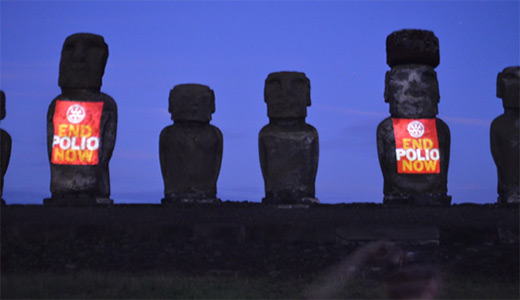
The stone statues are known as moai, the living faces (aringa ora) of deified ancestors of the Rapa Nui who inhabited the island. The Dutch navigator Jacob Roggeveen came upon the statues on Easter Sunday in 1722. The island has several ceremonial platforms, called ahu, upon which statues are displayed, and each is associated with a family of nobility.
The construction of the moai was quite an event. They average 10 to 16 feet in height, and weigh about five tons, although some are as heavy as 10 tons. Archaeologists have registered more than 1,000 statues around the island.
 Our goal was to light two of the 15 moai on Tongariki, the biggest ahu on the island located about 40 minutes from the town of Hanga Roa. The two figures we wanted to light are both unique, the second from the right is the only one with a hat, and the fifth from the right is the largest of the set.
But doing so is complicated. Besides the lack of electricity, the ahu are protected sacred sites. For our event, we needed authorization from the governor of Easter Island, the mayor of Hanga Roa, the National Corporation of Indigenous Development, and the senior council for the Rapa Nui.
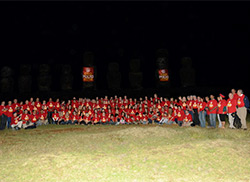
On 6 May, permission and equipment secured, about 45 members of Rotary and 70 Rotary Youth Exchange Students from Chile, all wearing red End Polio Now T-shirts, traveled to the island and gathered in front of the Tongariki with local residents for our effort to raise awareness for polio eradication and publicize just how close we are to ending this disease.
Once everything was ready, we went to the ahu and sat down for the official picture. We finally made it!
Learn how you can help us eradicate polio
* The crew of 45 Rotary members and 70 Youth Exchange
students pose for the official picture.